

Modern buildings need to balance aesthetics, daylight, ventilation, privacy and environmental performance.
One architectural element that can help address several of these requirements is the aluminium louver.
Aluminium louvers are increasingly used on commercial, residential and institutional buildings as both functional and architectural facade elements.
They can help control direct sunlight, provide visual screening, support ventilation and add depth to otherwise flat building elevations.
Alfa Facade Systems offers fixed and operable aerofoil louvers, HVAC screening louvers, sunshade and brise soleil systems, acoustic louvers, ventilation grilles and architectural facade fins.
What Are Aluminium Louvers?
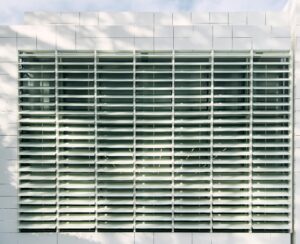
Aluminium louvers are a series of angled or horizontal/vertical blades designed to control the movement of sunlight, air and sometimes rain while maintaining a degree of openness.
Depending on the design, louvers can be:
- Horizontal
- Vertical
- Fixed
- Operable
- Decorative
- Solar-shading
- Ventilation-oriented
- Screening systems
They can be installed directly on building facades or around specific areas such as windows, balconies, parking structures and mechanical equipment.
1. Solar Shading
One of the major applications of architectural louvers is solar control.
Direct sunlight entering through glass can increase indoor heat gain and glare.
External shading devices can intercept sunlight before it reaches the glazing.
This makes louvers particularly useful for buildings with large glazed areas.
The effectiveness of a louver system depends on factors such as:
- Building orientation
- Latitude
- Sun path
- Blade angle
- Blade depth
- Window size
- Building geometry
Therefore, louver design should be based on the actual building rather than simply selecting a standard blade.
2. Improved Building Comfort
By reducing direct solar exposure, appropriately designed shading can help improve indoor visual and thermal comfort.
For office buildings, controlling glare can be particularly important because excessive sunlight can affect computer screens and occupant comfort.
Louvers can therefore become part of a broader facade strategy that combines:
Glass + solar-control glazing + external shading + ventilation + insulation
3. Ventilation
Louvers can also allow air movement while screening equipment or other areas.
This makes them useful for:
- HVAC areas
- Generator rooms
- Parking ventilation
- Utility spaces
- Mechanical plant areas
Alfa Facade Systems describes its louver systems as solutions for ventilation, solar control and visual screening.
4. Concealing Building Services
Modern commercial buildings often contain equipment that needs to remain accessible but is not visually attractive.
Louvers can screen:
- Air-conditioning equipment
- HVAC systems
- Generators
- Utility areas
- Parking structures
Instead of constructing a solid wall, a louver system can provide visual screening while allowing required airflow.
5. Architectural Design
Louvers are not only functional.
Architects can use them to create rhythm, depth and texture across a facade.
For example, vertical fins can emphasize the height of a building, while horizontal blades can create strong horizontal lines.
Different blade sizes, orientations, spacing and finishes can create very different architectural effects.
6. Fixed vs Operable Louvers
Fixed Louvers
Fixed louvers remain in one position.
They are commonly selected when the primary requirement is permanent shading, ventilation or screening.
Operable Louvers
Operable louvers can change position to control sunlight and airflow.
They may be manually operated or integrated with mechanical systems depending on the project.
The choice depends on the building’s performance objectives and budget.
7. Why Aluminium?
Aluminium is widely used for architectural louver systems because it offers a useful combination of low weight, durability and design flexibility.
It can be finished using methods such as powder coating or anodizing, allowing architects to coordinate louver finishes with other facade elements.
Aluminium also provides flexibility for custom blade profiles and facade configurations.
Structural Glazing vs Curtain Wall: What Is the Difference?
Read this blog
8. Louvers for Indian Buildings
India’s diverse climate makes solar control an important consideration for many buildings.
Depending on the location and orientation, buildings can experience:
- Strong direct sunlight
- High summer temperatures
- Glare
- Heavy monsoon rain
- Humidity
- Dust
A correctly designed external louver system can help address some of these facade challenges.
However, louver selection should always be based on project-specific environmental and engineering requirements.
Frequently Asked Questions
Do aluminium louvers reduce heat?
External louvers can reduce direct solar exposure to windows and glazed surfaces. Their effectiveness depends on orientation, blade geometry, spacing and the building’s solar conditions.
Can aluminium louvers be used for ventilation?
Yes. Louver systems can be designed to allow airflow while screening equipment or providing weather protection.
Are aluminium louvers suitable for commercial buildings?
Yes. They can be used on offices, commercial buildings, institutional projects, parking structures and other applications.
Are aluminium louvers only functional?
No. Louvers can also be used as architectural elements to create depth, shadow and visual rhythm on a facade.
Can louvers be customized?
Yes. Louver systems can be designed around project-specific requirements such as blade orientation, dimensions, spacing, finish and installation configuration.
Conclusion
Aluminium louvers can play several roles in modern building design.
They can provide solar shading, help manage glare, support ventilation, screen mechanical equipment and contribute to the visual identity of a building.
For best results, louver design should be integrated into the facade strategy from the early stages of a project.
Alfa Facade Systems provides architectural louver and sun-control solutions designed around building performance and architectural requirements.
Planning a facade with architectural louvers? Speak with Alfa Facade Systems about your project requirements.


